
The most-asked question when people see my art: how do you come up with what the animals are wearing? Hi, I'm Emma, an acrylic painter in Santa Monica, CA who loves painting animals in clothes. I usually give the short answer: "oh, they just have a personality to me and that informs the clothing choice." But in reality, it's a little more involved than that. Here's exactly how I go from a blank panel to a finished animal wearing their absolute best outfit.
Step 1 — Finding the Animal's Personality
The first step is deciding which animal to paint, which can happen in a few different ways.
Sometimes an animal chooses me — my Hippie Quokka came about because I fell down a rabbit hole of smiling quokka pictures online and quickly became obsessed. Other times I pick an animal because I know it's a crowd favorite, like elephants. And sometimes, like my ostrich, the animal just has an inherently silly look that perfectly matches the vibe I'm going for.
Then there's my favorite scenario: when the outfit idea comes first and I have to find the right animal to wear it. My Suave Hippo is the perfect example. I had this vision of a turtleneck and I thought, what animal would be absolutely hilarious squeezed into one? The hippo was the obvious answer. Logistically he was also the most challenging, but I was determined to make it work.
Once the animal is chosen, the personality tends to just appear. Sometimes I work through several outfit possibilities before landing on the right one; other times the idea arrives fully formed. I also have to think practically — occasionally I'll have an outfit in mind that simply doesn't work on the animal's body, and I have to pivot to something that makes more visual sense. The clothing has to feel like it belongs on them, even if "them" is a six-foot hippo in a turtleneck and blazer.
Step 2 — Sketching the Composition
Once I have the animal and outfit locked in, I sketch it out to work through proportions and make sure the idea actually holds up on a surface. If I'm really unsure whether something will work I'll sketch on paper first, but most of the time I go straight to the canvas or wood panel and sketch freehand, so I can move directly into painting from the same drawing.
Speaking of surfaces: I used canvas exclusively for years because that's what art school trained me on, and I'd never really explored alternatives. But my painting style is detailed and small, and the texture of canvas made fine detailing genuinely tricky. When I discovered wood panels, I knew immediately that the smooth surface was a much better fit for how I paint. Now I work almost exclusively on wood — it takes pencil beautifully for sketching and gives me the control I need for the detail work that comes later.
During this stage I also gather reference photos. For the animal, I'll pull three or four images in different poses and lighting conditions and combine them into the composition I'm after. I'll do the same for the clothing, focusing on nailing down shapes and silhouettes at this stage, even if the colors and patterns evolve later.
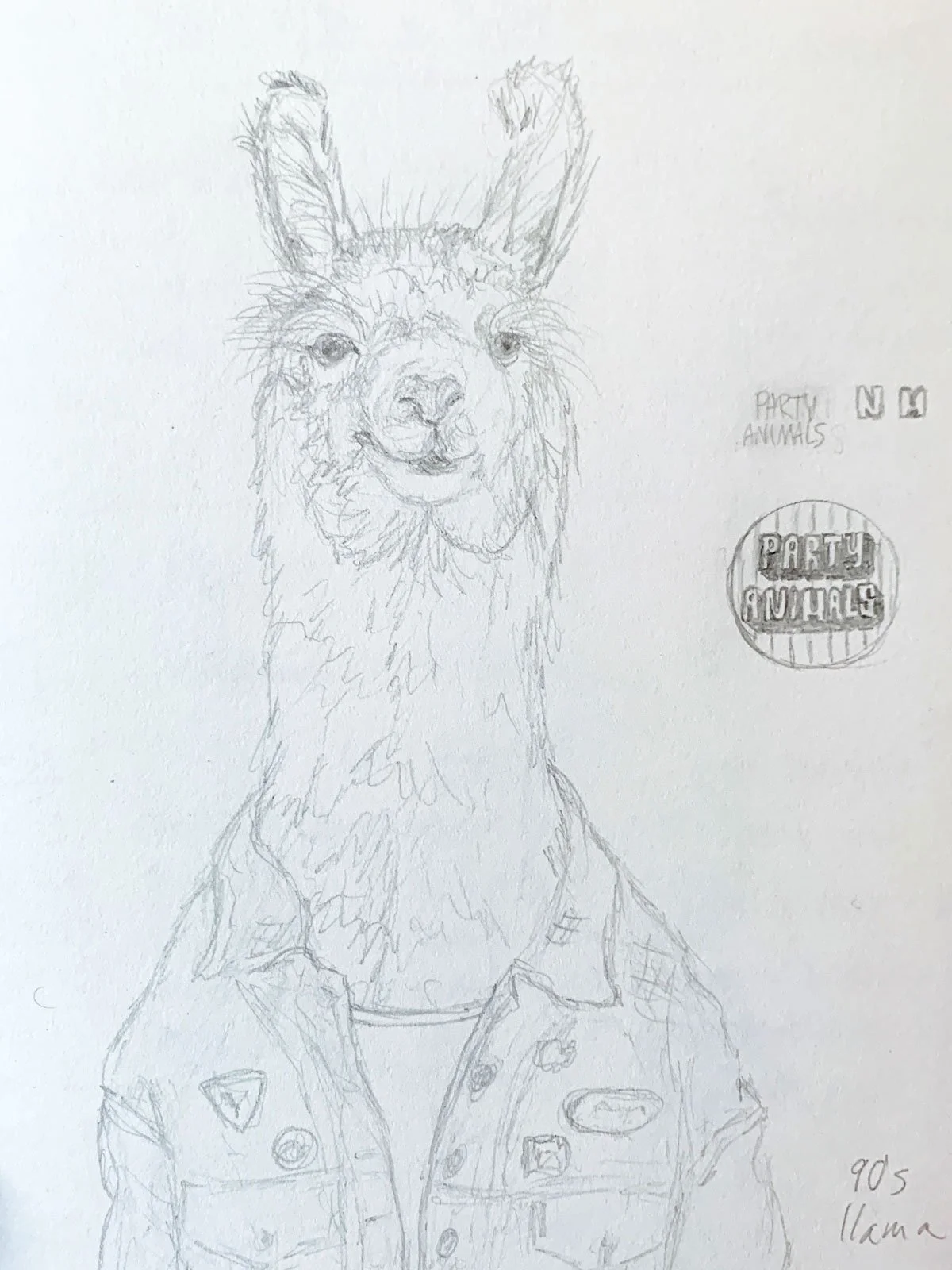
Initial sketch of my Party Llama painting. In this instance, I had a lot to work out so the sketch was on paper first.
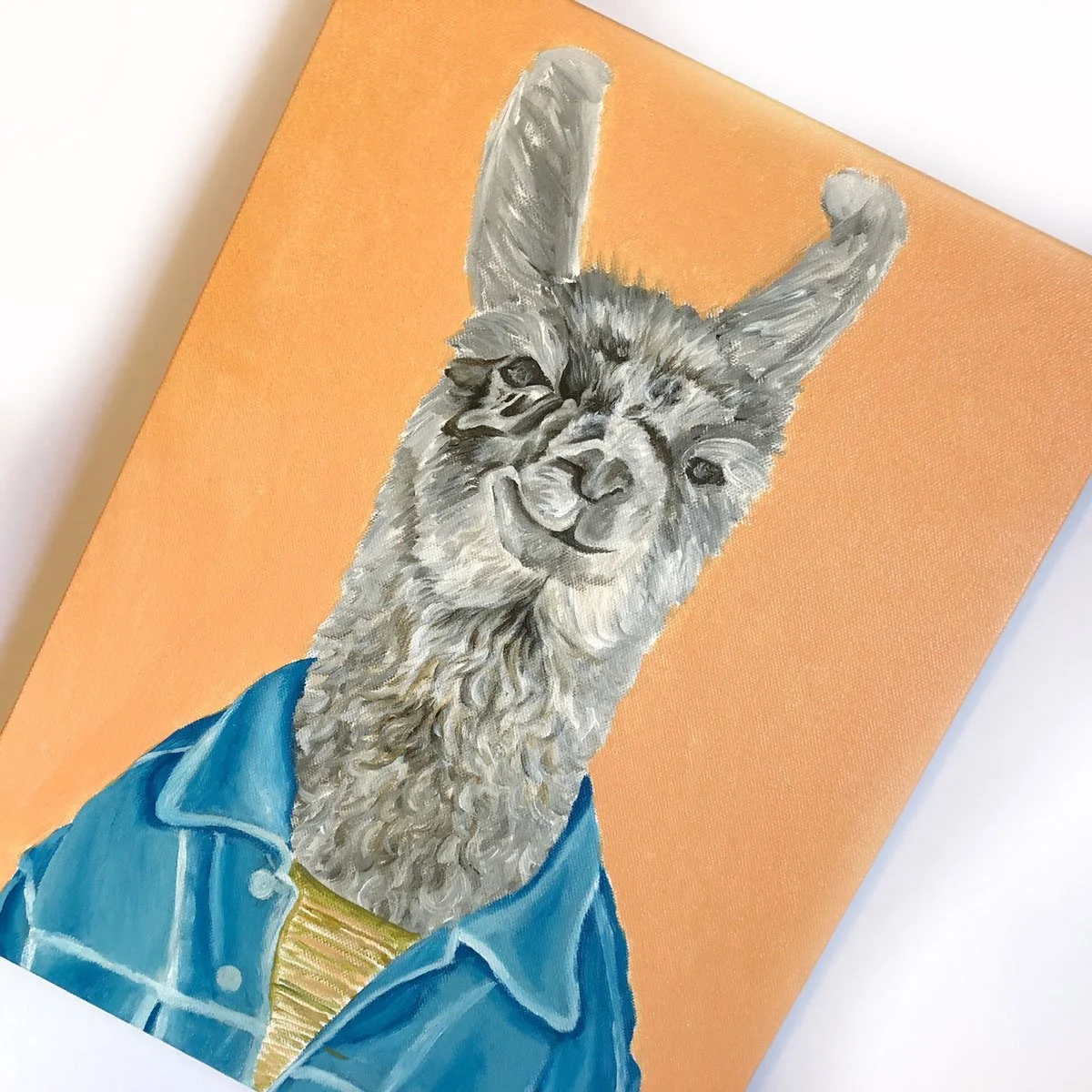
Initial color blocking for my Party Llama painting.
Step 3 — Building Up the Base Layers
With a sketch I'm happy with, I move into the base layer. I almost always start with the animal, using the same four paint colors I come back to for nearly every painting: yellow ochre, burnt sienna, raw umber, and titanium white. I use Golden acrylics and always mix in a gloss glazing liquid extender to slow the drying time, one of the trickier aspects of working in acrylics.
The base layer moves relatively quickly for me (I'm a slow painter in general, so take that with a grain of salt). The goal isn't detail, it's color mapping. I'm essentially replicating the sketch in color, laying down patches to follow in subsequent layers. If the animal has multi-tone fur, I block in those color zones loosely without worrying about texture yet.
Once the animal has a solid base, I'll do the same for the clothing and background. The colors aren't always fully decided at this point, I go with whatever feels right and know I can adjust later.
Step 4 — Painting the Animal's Face
The face is always the most time-consuming and tedious part of the process, and also the most rewarding. Before the detail work is done, I always feel like my unfinished painting is almost embarrassing to look at (if you’re an artist, I’m sure you know what I mean)! I know what it's going to become, but seeing the rough underpainting without the detail is always a little jarring, especially if anyone else catches a glimpse of it.
I work the face in sections. Since I paint around a full-time job and two kids, I rarely have long uninterrupted stretches of time. More often I’ll only have an hour or two to paint, so I'll pick one area of the face and work through it. I usually start with the fur, especially if it's long, since building up realistic texture takes multiple layers.
Halfway through I'll get to the eyes, and this is when the painting starts to come alive. Something about getting those small white highlights in just the right place makes me feel like yes, this is working. When I'm painting a custom pet portrait especially, finishing the eyes is the moment I finally feel confident that I've captured the individual animal. It's the detail that makes a painting feel like a portrait rather than just a picture of an animal.
Step 5 — Designing and Painting the Outfit
With the face mostly done, I turn my attention to the background and clothing. The first thing I do is finalize the colors for both, making sure everything works together and holds its own against the animal's natural tones. Since most animals sit in the brown and earth-tone family, I tend to reach for brighter, more saturated colors for the clothing and background — something on the opposite end of the color spectrum that makes the whole painting pop.
Background first: I keep these solid and relatively simple, specifically to contrast the texture happening everywhere else in the painting.
Then comes the clothing, which is simultaneously the most enjoyable and the most difficult part. Rendering fabric folds convincingly around an animal's body is genuinely subjective, and I'll admit I take some artistic license here. It's also the part of the painting where acrylics give me the most trouble. I learned to paint with oils, and I was spoiled by how naturally they blend. Getting smooth fabric folds in acrylics took years of experimenting before it started feeling intuitive, and I'm still learning.
My favorite part? The accessories and finishing details. A patterned pocket square, a pearl necklace, specific buttons. These are the details that bring the animal's personality fully to life, and they're some of the most satisfying moments in the whole painting process.
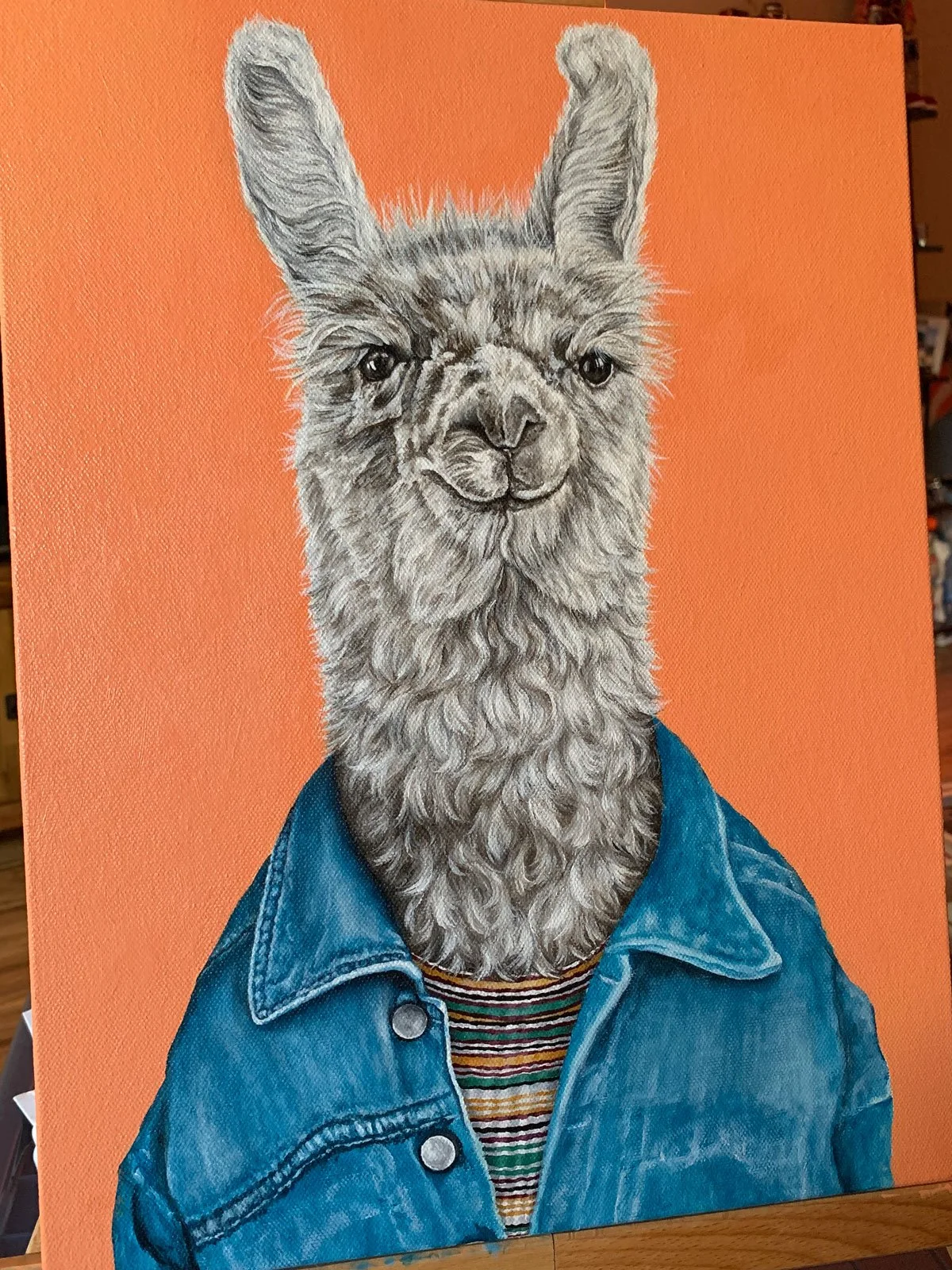
Party Llama is almost complete, working out the denim jacket and where the buttons will go.
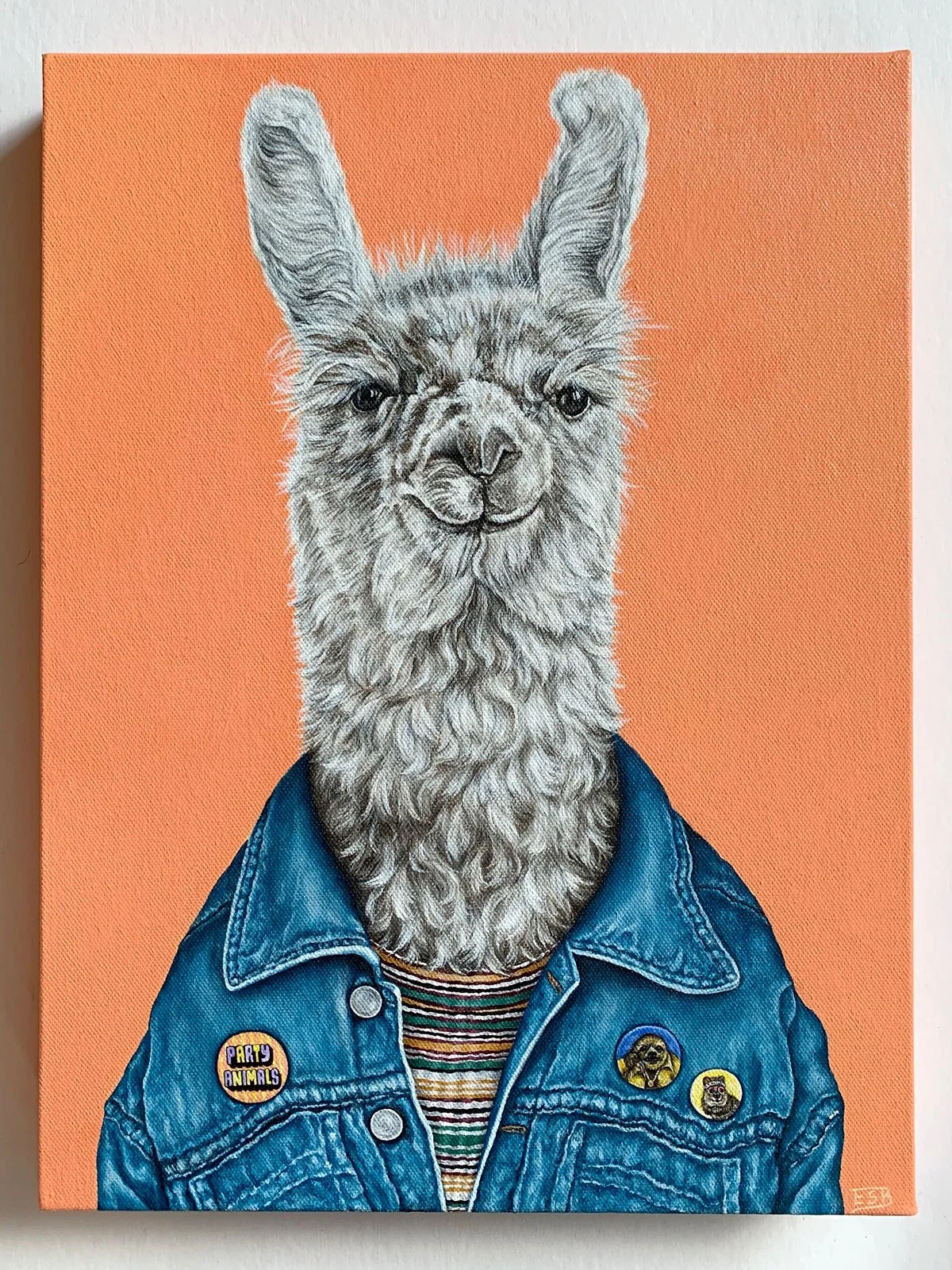
The final result: Party Llama wearing a denim jacket with Party Animal buttons.
Step 6 — Finishing Touches and Wrapping the Edges
The final stage is the finishing touches. I usually haven't completed the edges of the fur yet (I needed the background color in place first to paint against it cleanly) so this is when I refine those edges and add the small finishing details that make a painting feel complete: whiskers, final fur highlights, anything that needs one last pass.
I also finish painting the edges of the panel. I do this throughout the painting process, but any remaining work gets completed here. I wrap the actual painting around the sides rather than just painting them a flat color, partly because it means the piece is ready to hang without a frame, and partly because I love the idea of someone turning a painting over and finding a little continuation of the scene tucked around the edge.
And then, somewhere in there, I decide it's done. That moment is always a little hard to identify, there's no clear finish line with painting. But at some point I look at the animal in their outfit, and they just feel like themselves.
Want to See More of My Work?
If you made it this far, there's a good chance you might want to see the finished results! Browse my Original Paintings to see the full Party Animals collection, Dogs in Glasses, Cats in Tiny Hats, and more. And if you've ever wanted your own pet painted — in clothes or without — you can learn more about my custom pet portrait commissions here.
Acrylic Painting Process FAQs
-
I prefer using Golden acrylics, and always mix in a liquid extender to lessen the drying time. My most used colors are yellow ochre, burnt sienna, raw umber, and titanium white — I’ve found you can mix just about any fur color with these.
-
Honestly, it varies — the size and detail level of the painting plays the biggest role. I also only have time to paint for a couple of hours a week squeezed around a full-time job and two kids. All things considered, most paintings take me somewhere between one and three months to complete.
-
Yes! I do take a limited number of commissions, though I do my best work when the subject plays to my strengths. I'm happiest painting animals — whether that's a custom portrait of your own pet, or an original animal painting in one of my existing series styles. If you have an idea that feels like it belongs in my world, I'd love to hear it. The best way to find out if we're a good fit is to reach out and tell me what you have in mind.
-
Absolutely — custom pet portraits are actually one of my most popular services. I paint dogs, cats, and any other animal you can throw at me, either plain or with a clothing or accessory add-on if you want to lean into the fun. You can learn more about the process and pricing on my Custom Pet Portraits page, or jump straight to dog portraits or cat portraits if that's what you're after.